
Best Essential Oils for a Home Spa Diffuser — Three That Make the Bathroom Worth Closing the Door For
The towels are folded. The door is shut. The diffuser sits on the edge of the tub like it belongs there, and for the next hour, this room is not a bathroom. It is somewhere else entirely. Choosing the best essential oils for a home spa diffuser is the same kind of decision as choosing the tile or the towel — it comes down to what the room feels like when you walk in.
When the Smallest Room Becomes the Quietest One
A home spa is not a renovation. It is a mood. It happens when you run the water hotter than usual, dim the overhead, and let something fill the air that was not there before. The diffuser does the work that candles used to, but cleaner. No wax residue on the vanity. No wick to trim. Just vapor, rising into warm air, settling on tile and glass and the folded edge of a robe.
What matters is not how many oils you own. It is whether the ones you reach for actually belong in a small, humid, warm room. Some scents collapse in steam. Others open up. Eucalyptus is one that thrives in it — bright, sharp, built for exactly that kind of air. Peppermint does the same. Tea tree runs cooler, greener, almost mineral. Together, they make a bathroom feel like a room with altitude. Somewhere north. Somewhere stone.
Three Oils in a Sage Green Box
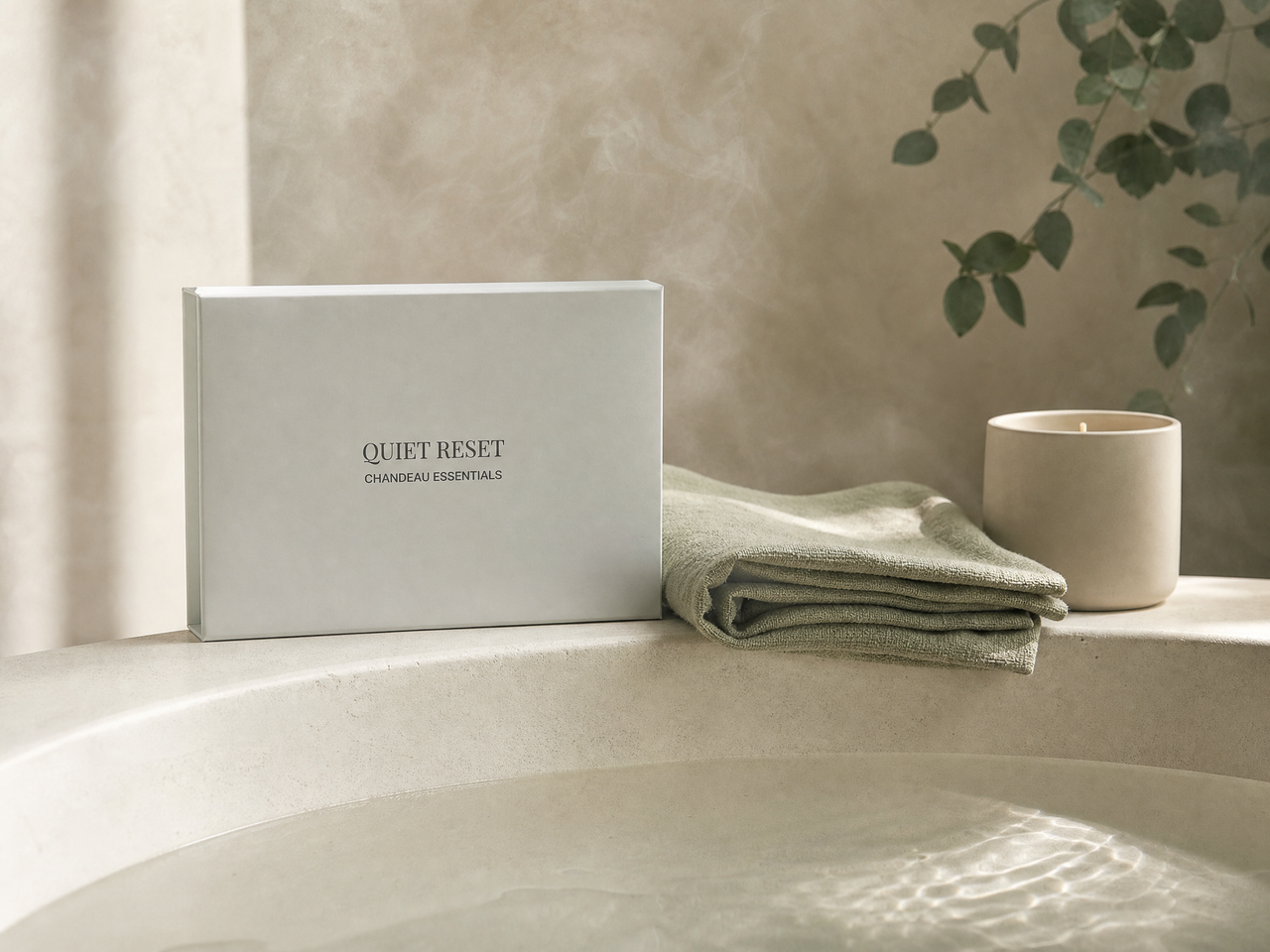
The best essential oils for a home spa diffuser are not always the ones you expect. Lavender gets suggested constantly. It is fine. But for this particular hour — the hot water, the closed door, the deliberate quiet — something with more edge reads better. Eucalyptus, tea tree, peppermint. That is the entire lineup inside the Quiet Reset bundle.
All three are organic. The box is sage green, which matters if it sits out on the shelf between the soap and the hand towel. Three bottles, dark glass, no fuss. You add a few drops before you step in. The room shifts. It is cooler on the nose without being cold. Clean without smelling like cleaning. The kind of air you notice once, then stop noticing, because it just becomes the room. This three-oil set does not try to be everything. It tries to be one good hour.
Choosing a Diffuser That Stays Out of the Way
The oils matter. So does the machine. A good diffuser for a bathroom is small, ceramic or matte-finish, and quiet enough to forget. Ultrasonic models work well in humid rooms — HGTV's diffuser roundup notes that compact ultrasonic options suit smaller spaces where you want vapor without noise. Look for one with a simple timer. No app. No colored lights cycling through the spectrum.
Organic oils run thinner and lighter than synthetic blends, which means they diffuse more evenly and leave less residue in the reservoir. That is the practical reason to use them. The other reason is just how they smell — less sweet, less manufactured, closer to the plant. If you already have the Quiet Reset on the shelf and want something for the evenings when the bath is less about sharpness and more about settling down, the Soft Evening bundle — lavender, orange, eucalyptus — is the gentler counterpart. Same shelf. Different hour.
A Ritual That Fits in a Small Room
There is something honest about a bathroom ritual. It cannot be scaled up. It cannot be optimized. The room is small. The hour is short. You are not going anywhere. You fold the towel, fill the diffuser, close the door. That is the whole thing.
The oils you choose become the character of that hour. Peppermint makes the air feel thinner. Eucalyptus makes it feel wider. Tea tree makes it feel still. Together, they do not compete. They just layer — the way cold air layers over warm water.
The best essential oils for a home spa diffuser are the ones that change the room without trying to change you. A few drops in the reservoir. Steam on the mirror. The Quiet Reset bundle on the shelf. The door stays closed for as long as you want it to.